
Forza Horizon 6 · 2026-10-13
Japan’s parking-lot car culture takes center stage as Horizon Meets brings 7-Eleven to Forza Horizon 6
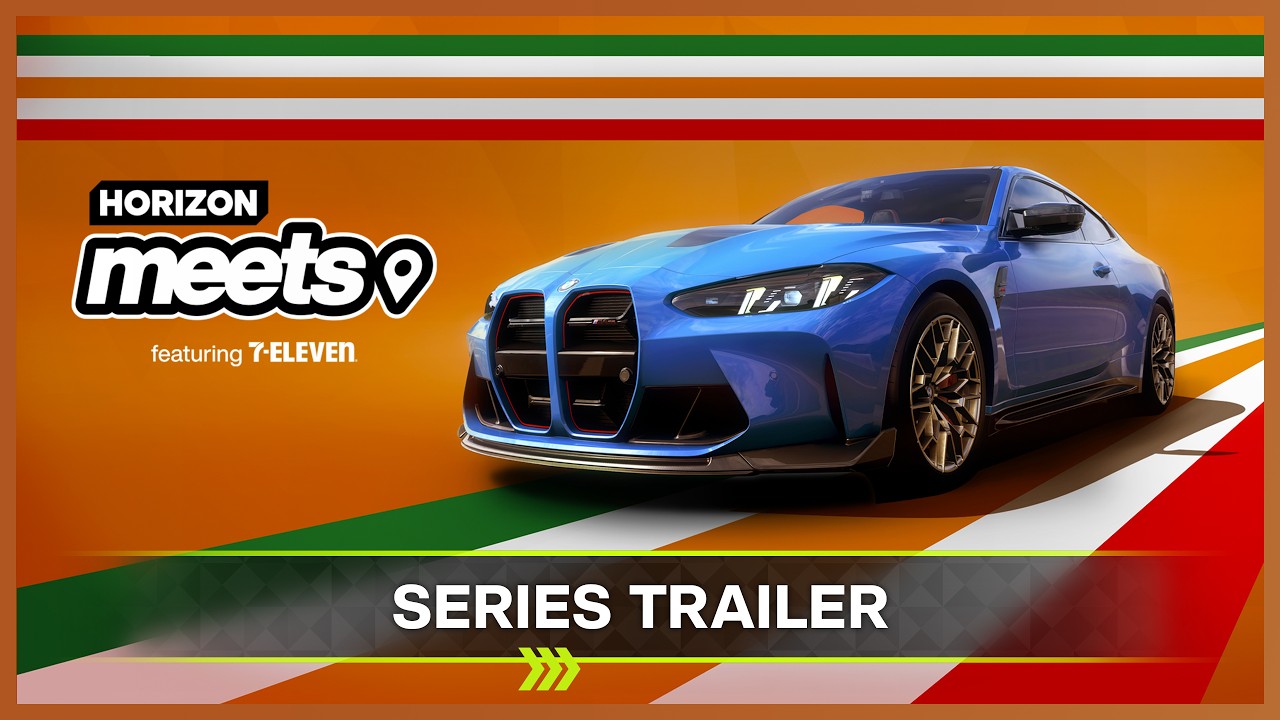
The fastest car is not always the one everybody gathers around. Forza Horizon 6 is putting the social side of automotive culture at the centre of its latest Series update with Horizon Meets, transforming part of Japan into a temporary 7-Eleven gathering spot where players can park their builds, inspect other cars, exchange liveries and tunes, and treat the open world as somewhere to hang out rather than another road connecting one race to the next.
The new Horizon Meets Series Trailer highlights the collaboration between Xbox and 7-Eleven, but the update is considerably larger than its branded konbini. Three cars make their Horizon debuts, another Treasure Car has been hidden somewhere in Japan, Horizon Play receives 200 additional progression levels, ten more vehicles join Spec Racing and Playground Games is continuing to expand the game’s EventLab toolset. The Festival Playlist began on October 8 and runs through November 5, making the temporary Car Meet the focal point of Series 6 before Horizon Japan moves on to its next Evolving World transformation.
A 7-Eleven overlooking Mount Fuji becomes Horizon’s newest meeting place
The centrepiece of the collaboration is a temporary 7-Eleven-themed Car Meet in the Nangan region, positioned near the Nangan Day Trip in a setting inspired by a Japanese konbini with Mount Fuji visible in the distance. Playground Games has deliberately chosen a location that works as much as a photography destination as it does a functional meeting point, fitting Horizon Meets’ broader theme of asking players where they actually like to gather when they are not racing.
Car Meets already provide one of Forza Horizon 6’s more explicitly social spaces. Players can pull in with their current vehicle, examine other people’s customised cars and access the liveries and tuning setups being displayed. The 7-Eleven version takes that familiar functionality and wraps it in something much more specific to Horizon 6’s Japanese setting: the ubiquitous roadside convenience store becomes the kind of place where a convoy can stop, photograph its cars and decide where to drive next.
The location itself is temporary and belongs to Horizon 6’s Evolving World, so it will disappear once Series 6 concludes. Playground is avoiding the usual problem with temporary branded environments, however, by also adding the complete konbini to EventLab. Even after the official Nangan location is removed from the world, creators will be able to keep using the building in their own circuits, photo spaces and custom Car Meets.
The EventLab pack lets players build their own 7-Eleven meets
The collaboration contains 17 new EventLab props, covering far more than the convenience store itself. The selection includes several 7-Eleven flags and signs, branded and unbranded E-Z UP tents, a vending machine, storage crates, road barriers, metal railing and, most importantly, the complete konbini building used for the temporary Evolving World location.
Those objects can also be incorporated into Garage and Estate creations, meaning the collaboration is not restricted to conventional EventLab races. A creator could recreate a compact roadside meet, turn a garage into a branded workshop area or build a much larger custom festival around the store.
That may ultimately give the collaboration more longevity than the official Car Meet. Licensed environments often disappear once a promotional series ends, but giving the community the actual construction pieces allows the location to survive through shared events long after November 5. For a series specifically themed around places where players congregate, allowing them to design those places themselves is a logical extension of the idea.
Egg sandwiches, uniforms and badges push the collaboration further
Playground has also embraced some of the smaller details associated with Japanese convenience stores. Horizon Meets introduces an Egg Salad Sandwich collectible, inspired by the tamago sandwiches sold by 7-Eleven in Japan, while the first week of the Festival Playlist includes a photography challenge at the Car Meet that unlocks a 7-Eleven Clerk Uniform for the player avatar.
Two new Badges are connected with the update as well. Merely participating in Forza Horizon 6 during Horizon Meets awards the Welcome! Badge, while another challenge involving the new Honda Prelude Type SH and the konbini unlocks Please Visit Again!. Even the two new Car Horn rewards continue the theme, with Konbini and Noodle Slurp joining the audio collection.
None of these additions materially changes how Horizon 6 drives, but they help make the collaboration feel like a complete seasonal theme rather than a single branded building dropped onto the map. Playground has increasingly used Series updates this way, temporarily altering the atmosphere of Horizon Japan while preserving selected pieces through rewards and EventLab once the world moves on.
The 2000 Honda Prelude Type SH leads the first week
The first of the three cars making their Horizon debut is the 2000 Honda Prelude Type SH, available for 20 Festival Playlist points during the Summer season from October 8 to October 15. It arrives as a C 455 front-wheel-drive car producing 200 horsepower from its 2.16-litre four-cylinder engine.
The important part is the Type SH specification. The name stands for Super Handling, with Honda fitting the fifth-generation Prelude with its Active Torque Transfer System. Rather than relying on raw power, the system was designed to improve the behaviour of the front-wheel-drive coupe through corners by actively distributing torque to reduce the understeer normally associated with pushing a powerful front-driven car hard.
That makes the Prelude a particularly appropriate reward for Horizon 6. Japan’s map naturally encourages touge runs and technical road driving, while the game’s upgrade system gives players plenty of room to decide whether to preserve the car’s original balance or turn it into something considerably more extreme.
It also becomes part of the 7-Eleven collaboration itself. Bringing the Prelude to the new Car Meet unlocks one of the Series badges, making the first new vehicle more closely integrated into the theme than simply placing it at the end of a points requirement.
The BMW M4 CS is the main four-week Series reward
Players willing to accumulate 80 points across the complete Horizon Meets Series can unlock the 2025 BMW M4 CS, the second major Horizon debut and by far the quickest of the three headline additions in stock form.
The real M4 CS sits between BMW’s M4 Competition and the more uncompromising CSL philosophy, combining extensive carbon-fibre weight reduction and chassis changes with a 3.0-litre twin-turbocharged inline-six producing 543 horsepower and 479 lb-ft of torque. BMW sends that power through an eight-speed transmission and M xDrive all-wheel-drive system, giving the production car a quoted 0–60 mph time of approximately 3.2 seconds.
Forza places it in S1 733, making it immediately useful for much faster competitive events than the Prelude or Monaro. That range is one of the strengths of the Series lineup: Horizon Meets is supposedly about cars people gather around, not one particular category of motorsport, so an early-2000s Honda coupe, modern German performance car and 1960s Australian muscle machine can all occupy the same Festival Playlist without needing to share much mechanically.
The M4 CS remains available for the whole Series until November 5, giving players substantially more flexibility than the weekly 20-point rewards.
The Holden Monaro closes the Series with Australian muscle
The third newcomer arrives much later. The 1968 Holden Monaro GTS 327 becomes the 20-point Spring reward from October 29 through November 5, bringing one of Australia’s foundational muscle cars to Horizon for the first time.
Its 5.36-litre Chevrolet-derived V8 sends 249 horsepower and 325 lb-ft of torque to the rear wheels in Playground’s stock configuration, placing it down in D 366. That figure looks modest beside the BMW, but outright performance is only part of the Monaro’s significance. The GTS 327 became closely associated with Holden’s early motorsport success, including the famous 1968 endurance race at Mount Panorama where Monaros filled the first three positions.
Horizon 6’s enormous modification system should make the car particularly appealing to builders because there is such a large gap between its period-correct starting point and what players can eventually create. It can remain an old-school V8 cruiser, become a historical racing recreation or be transformed into something carrying vastly more power than Holden could realistically have contemplated in 1968.
That customisation potential fits Horizon Meets almost better than outright racing success. A Series based around showing up with something interesting benefits from cars whose appeal begins before the stopwatch starts.
DeBerti’s Mustang and the Saleen S7 make their Horizon return
Three completely new cars headline the Playlist, but two notable vehicles also return from earlier Forza Horizon games. The 2018 DeBerti Ford Mustang GT arrives as the 20-point Autumn reward from October 15–22, followed by the 2004 Saleen S7 during Winter from October 22–29.
The DeBerti Mustang represents the heavily modified side of car-meet culture. Its 5.0-litre V8 is supplemented by a Roush supercharger, and the car carries extensive custom bodywork including a widebody conversion and bespoke aerodynamic pieces. In Horizon 6 it produces 750 horsepower and sits at S1 733, meaning the appearance is backed up by genuinely serious performance.
The Saleen S7 goes in a different direction. It is one of the defining American supercars of the early 2000s, built around a carbon-fibre body and mid-mounted 7.0-litre V8 producing 575 horsepower in the version Playground has selected. Its return is particularly appropriate for a Series about what people bring to a meet: the S7 remains rare enough in reality that simply seeing one parked would probably be more memorable than watching most ordinary cars race.
Additional weekly rewards include established Horizon cars such as the Toyota Corolla SR5, Nissan 370Z, Audi Sport quattro S1 and Honda CR-X SiR, taking the total Festival Playlist reward selection to ten vehicles over the four-week Series.
A Citroën 2CV is hiding somewhere completely different
Horizon Meets also adds a new Treasure Car, and Playground has deliberately chosen something far removed from the high-performance machinery dominating much of the update. Somewhere in Japan is a 1970 Citroën 2CV, waiting for players capable of interpreting the accompanying photo clue and locating it in the open world.
Treasure Cars turn vehicle collection into exploration rather than progression. Instead of accumulating Playlist points or purchasing the car through the Autoshow, players have to use the clue and environment to determine where the missing machine is located.
Choosing a 2CV adds some welcome absurdity to the exercise. The tiny French economy car is one of the most recognisable vehicles of the twentieth century, but nobody is going to confuse it with an M4 CS or Ferrari F40. Its appeal is cultural rather than numerical, which again fits an update focused on the variety of vehicles enthusiasts value rather than simply adding another collection of faster cars.
Horizon Play gains 200 more levels
Players who spend substantial time in Horizon Play now have another long-term progression target. Horizon Meets adds 200 additional levels together with 20 new Player Badges, with one Badge awarded for every ten levels completed.
Playground has also made the expansion retroactive. Anyone who reached the previous level cap and continued accumulating Horizon Play XP has not wasted that progress; excess experience earned before the update is automatically applied to the new levels after logging in.
That is a relatively small quality-of-life decision with significant consequences for the most active players. Raising a progression ceiling without recognising months of accumulated activity would effectively penalise the people who had engaged most heavily with the system. Carrying the excess XP forward instead means veteran players may immediately find themselves well into the expanded track.
Ten more cars make Spec Racing significantly broader
The Spec Racing roster receives one of Horizon Meets’ largest permanent expansions, with ten additional cars becoming available in the standardised competition format. The newcomers are the 2019 Ginetta G40 Junior, 2020 Lamborghini Essenza SCV12, 1990 Alfa Romeo SE 048SP, 1992 Mazda RX-7 Type R, 2008 Mazda Furai, 2023 Audi R8 Coupé V10 GT RWD, 1987 Ferrari F40, 2017 Saleen S7 LM, 1967 Ferrari #24 Spa 330 P4 and 1990 Nissan #12 Skyline GT-R BNR32 Gr.A JTC.
The most important detail is that Spec Racing access is independent of ownership for three normally paid DLC cars. The Alfa Romeo SE 048SP, Audi R8 V10 GT RWD and Nissan Gr.A Skyline belong to paid content elsewhere in the game, but everyone can drive them in the Spec Racing playlist without buying their corresponding DLC.
That separation is important for a competitive mode built around putting everyone into comparable machinery. Paid vehicle ownership can expand somebody’s personal garage without automatically dividing the available multiplayer field into players who bought a particular pack and players who did not.
Horizon Meets also adds Edamame Circuit to more Horizon Play activities. Originally introduced with the Horizon Mascot Party update, it can now appear in Horizon Drift across all PI classes, Spec Racing for B and C class and Horizon Racing in B class.
The 7-Eleven location has its own hidden dealership opportunity
The new konbini is not merely a parking lot. Behind the location, Playground has placed an Aftermarket Car selection containing rare or discounted vehicles, creating another reason to visit even for players who are less interested in taking photos.
The official Series announcement specifically highlights the 2008 Mazda Furai and 1989 Toyota MR2 SC, both returning from the earlier Welcome to Japan Series, alongside the normally Wheelspin-exclusive 1998 Mercedes-Benz AMG CLK GTR. The wider rotating selection also gives collectors another path toward cars that can otherwise be inconvenient to acquire.
This fits one of Horizon 6’s better ideas around social locations: places where players gather can also function as discovery points. A Car Meet becomes more useful when there is a mechanical reason to visit beyond watching other people idle in the parking lot, and attaching rare automotive inventory to the location gives even solo players a reason to make the journey.
The real-world collaboration extends beyond the game
Xbox and 7-Eleven are also running a separate North American retail promotion, although its rewards should not be confused with the globally available Horizon Meets content. Eligible 7Rewards and Speedy Rewards members in the United States and Canada can obtain an exclusive 7-Eleven-wrapped Toyota GR Supra livery through qualifying Xbox Gift Card purchases at participating 7-Eleven, Speedway and Stripes stores.
The promotion runs through October 27 and also connects with a physical merchandise collection featuring Forza Horizon 6, 7-Eleven and Toyota designs. Shirts, hoodies, outerwear and accessories use Japanese-inspired automotive artwork rather than simply reproducing the in-game storefront.
That geographic limitation matters. The temporary Nangan Car Meet, EventLab props and core Series content are part of Horizon 6 itself, whereas the Supra promotion is tied to participating North American retail locations and should not be treated as a standard Festival Playlist reward.
Four more Car Pass cars arrive during Horizon Meets
The Series also continues Forza Horizon 6’s separate Car Pass rollout, adding one paid vehicle each Thursday. October 8 brought the 1972 Datsun 240Z #5 Rallye, followed by the 2024 Ferrari Purosangue on October 15, the 1990 Eunos Cosmo on October 22 and the 2024 Mercedes-AMG GT 63 4Matic+ on October 29.
The choices cover almost the complete spectrum of the update. The Datsun adds historic Japanese rally competition, the Purosangue brings Ferrari’s naturally aspirated V12 into a four-door format, the Eunos Cosmo represents the technological eccentricity of early-1990s Japan with twin-turbo rotary power, and the modern AMG provides another high-output all-wheel-drive grand tourer.
These cars are not part of the free Festival Playlist rewards. Car Pass is included with the Deluxe and Premium Editions and Premium Upgrade or can be purchased separately, so Horizon Meets effectively runs two parallel vehicle pipelines throughout October: earnable Series rewards and weekly premium additions.
Completionists get another long-term target with the Lamborghini Espada
Playground is also continuing Series History Rewards, which encourage players to accumulate points across multiple Festival Playlists rather than treating each month as entirely disposable. Reaching 1,100 points unlocks the 1973 Lamborghini Espada 400 GT.
That requirement obviously cannot be completed through Horizon Meets alone. It is aimed at players who have consistently participated across Horizon 6’s previous Series and provides another reason not to abandon Playlist objectives immediately after earning whichever weekly car happens to be most desirable.
The Espada itself is a fitting reward for collectors because it represents a very different side of Lamborghini from the modern supercars that dominate most racing games: a front-engined V12 grand tourer with four seats and styling unmistakably rooted in the late 1960s and early 1970s.
Horizon Meets understands that car culture is not just racing
The most interesting part of Series 6 is not any one vehicle. Horizon Meets recognises that much of enthusiast culture happens when the cars are stationary. People spend enormous amounts of time choosing wheels, refining suspension setups, reproducing real liveries, building ridiculous conversions, photographing their work and then driving somewhere specifically to show it to other people.
Forza Horizon has always supported that behaviour mechanically, but its progression systems naturally push players toward races, PR Stunts and challenges. Building an entire Series around gathering gives those quieter parts of the experience more visibility. The 7-Eleven collaboration works because a convenience-store parking lot is deliberately less glamorous than a Horizon Festival stage. It looks like somewhere enthusiasts might actually decide to stop during a night drive.
The three headline reward cars reinforce that diversity. The Prelude is a front-wheel-drive Japanese coupe defined more by handling engineering than headline output, the Monaro represents historical Australian muscle and the M4 CS applies modern technology to an increasingly specialised performance car. None needs to be the “best” vehicle in the update for all three to be interesting at the same meet.
That is ultimately what Horizon Meets is selling: not another championship, but the question of what you would bring when everybody else parks up.
Tokyo City becomes the focus again after the meet ends
Horizon Meets will remain active through November 5, after which Playground has already confirmed the broad theme of the next Series. The following update will shift attention toward City Life, celebrating Tokyo with two additional permanent race routes, another three cars making their Horizon debut and a fresh EventLab Prop Pack.
That makes the 7-Eleven Car Meet another temporary stage in Horizon 6’s attempt to keep Japan visibly changing between Series. The official konbini may disappear, but its EventLab pieces, cars, Horizon Play expansion, Spec Racing additions and Treasure Car will remain behind as permanent evidence of what Series 6 added.
For the next few weeks, however, the destination is considerably simpler. Horizon Meets is live now in Forza Horizon 6, with its Festival Playlist running from October 8 through November 5 on Xbox Series X|S and PC. Bring a car worth looking at, park beside the konbini and worry about who is fastest after everybody has finished taking photos.